''Only we humans make waste that nature can't digest.''
What is the Great Pacific Garbage Patch?
The Pacific 'garbage soup' as it is commonly referred to, stretches from China to California, covering an area larger than the continental United States, 80% of which is made up of tiny, non biodegradable shards of plastic.
Since Petroleum based plastics are non biodegradable, any entering the oceans remain there, breaking into smaller and smaller pieces until they are ingested or deposited on some distant shore.
The catastrophic effect this amount of human waste is having on the environment is the most evident with marine and bird life who constantly mistake this rubbish for food. Sea bird carcasses have been found with alarming volumes of plastic in their bellies, ranging from bottle caps to lighters to fragments of styrofoam.
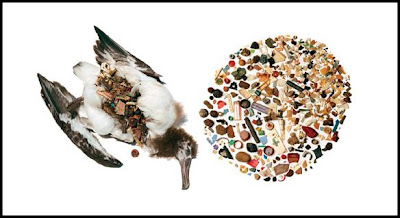
The dead body of a fledgling Laysan albatross with more than half a pound of plastic in its stomach.
Contents of another bird's stomach, over half of which is human waste.
Plastic bags, often mistaken for jelly fish, have led to the suffocation of thousands of turtles. Items such as plastic rings and six-pack holders have also resulted in some excruciating and shocking deformations.
With such effects being evident on wildlife, many concerns have naturally risen about how our own food chain is being effected. With this in mind, studies on hundreds of samples of the most common fish in the ocean (some at the bottom of the food chain) showed that over one third had polluted plastic fragments in their stomachs. The record holder - one small specimen only 2.5 inches long, had 84 pieces in its tiny stomach. The leading authority on the subject, Captain Charles Moore of the Algalita Marine Research Foundation who first discovered the Great Pacific Garbage Patch has gone as far as stating: ''You can buy certified organic produce, but no fish monger on earth can sell you a certified organic wild caught fish.''
One may of course take this opportunity to point out that these issues are simply not relevant on our island, being so far from the Pacific Ocean and protected by such a narrow opening at the Gibraltar Strait. Unfortunately, however, as a regular volunteer of the group 'That's Rubbish', evidence on our very own beaches have revealed a worrying similarity to the problems occurring half way around the world. The strong currents around the beautiful beach of Ghajn Tuffieha, especially during the winter months, have dragged in vast amounts of discarded items including fishing nets, rope, bottles, large plastic containers, and the most common items - hundreds upon hundreds of bottle caps and thousands of small fragments of plastic. These tiny particles appear to be identical to those discovered in the Pacific 'garbage soup', in their birds and in their fish. As it can take years for containers to break down to these minute sizes, one can only imagine how long these items have been floating around the sea, and how many of them have ended up in the stomachs of the fish we may have consumed.
Ghajn Tuffieha, 27th December 2009.
So what is the solution to this great ocean threat?
Captain Moore has stated that realistically, completely eliminating the plastic content of the ocean is now beyond the budget of any country and the damage it has created until now is quite possibly irreversible. Our responsibility now lies in preventing even further damage by stopping the plastic at its source - stopping it on land before it finds its way into the sea.
So, what can you do?
Reduce the amount of plastic you use.
~ Give up plastic sandwich bags and use long lasting tupperware instead.
~ Stop buying bottled water (some households can get through over 1000 2L bottles a year). Consider installing a small reverse osmosis system to purify tap water which can pay for itself within 12 months.
~ Instead of buying a drink for lunch every day, bring one with you from home and re-use the bottle.
Bin it.
~ It takes half a second to slip whatever you're done with in your pocket until you find a bin to dispose of it safely.
Recycle.
~ With local councils picking up recyclables from our very doorsteps on a weekly basis, we have no excuses to not recycle.
Educate.
~Forward this article to family and friends.
~ Lead by example and influence the people around you into picking up more responsible habits.
Act.
~ Join us on one of our beach clean ups. See a fraction of what is out there littered on our shores and help us keep that mound of rubbish from polluting and killing the sea's beautiful creatures.
~ Know of an area by the coast that's in a bad state? Get in touch with us at info@thatsrubbishmalta.com and we'll try to help you organise a clean up there.
Paul Watson, one of the greatest wildlife conservationists of our time, once said ''If the oceans die, we die.''
The strong winter currents once again piled tonnes of rubbish onto the beach, the far side being so bad we could barely see the ground beneath it. It was a shocking site, even to the regulars of the group. The bewildering question on everyone's mind.. who on earth was throwing all of this into the sea? With such a large volume of the rubbish looking like edible material to marine life, it was a sad reminder of how little respect some individuals have for the illusive creatures of the mediterranean, such as turtles, dolphins and sharks.
Bad weather cut the original clean up short but didn't stop a handful of determined volunteers from collecting an impressive amount of trash despite the wind and rain.
Two days later a few of us managed to get back down to the beach to finish off what the others had started and collected close to 20 bags full.
A cleaner beach for all to enjoy and a good many turtles with less plastic to suffocate on. Big thanks to all who joined!
A handful of the usual dedicated volunteers and several new faces were met with hot weather despite it being the end of November. This time, an even greater emphasis was made on separating the recyclable items from the rest of the rubbish. We can across long lines of rope washed in by the sea, half a BBQ set and an entire curtain!
Many ripped lengths of plastic were also found buried in the sand, most likely having been thrown overboard industrial ships.
Another great clean up with smiles of satisfaction all round!
As we slipped on our gloves at the windy beach, a swarm of foreign students made their way down the Ghajn Tuffieha steps. Much to our surprise, instead of pulling out towels and drinks, they walked straight up to us and asked for bags, turning an 8 man team into our record turn out of 26 volunteers.
Two hours and 32 bags of rubbish later, we heaved everything back up to the roadside to be picked up and taken to the landfill where it all belongs. We would like to thank the ever supportive regulars and each and every one of our surprise student volunteers for giving up your Sunday afternoons to give us a helping hand. Cheers!
With the beach being so packed this time round, most of us headed to the outskirts of the area in groups. Shoes, rusty old chairs, rope, the usual tons of plastic and cans... we found it all.
The highlight of the evening was a group of kids who came up to us asking for gloves and bags to help out. They rushed into the crowd and came back with a somewhat alarming stash of cigarette butts.
Our thanks to the nameless youngens who spent their evening cleaning up after the so called responsible adults who littered the sand in the first place!
Yet another great turn out with plenty of new faces in the team. The beach was quiet so we managed to give it a thorough seeing to and had it looking spotless in no time.
We then relaxed until sunset and enjoyed getting to know the new guys a little better over cold drinks. Another great day in the company of awesome people.
The number of new volunteers took us aback as we met up in the Ghajn Tuffieha car park - family, friends, friends of friends and even complete strangers were turning up to give us a hand.
With well coordinated teamwork the SAS would be proud of, we hauled in our biggest heap of rubbish yet.
Seeing so many people work together for a common cause was an awesome experience - one we hope to repeat over and over to maintain the beauty of our shores.